A profitable business can still run out of money. That sentence sounds like a contradiction until you’ve lived through it once, and then it becomes the single most important lesson you carry forward. I’ve watched a friend’s business post a healthy profit on paper for the year and still nearly miss payroll in March, because the profit was sitting in unpaid invoices and the payroll obligation was due in cash, this week, regardless. Profit is an opinion; cash is a fact.
Cash flow gaps aren’t a sign of a bad business. They’re a timing problem, and timing problems are manageable once you see them coming. Here’s how I think about staying ahead of them.
Map the gap before it maps you
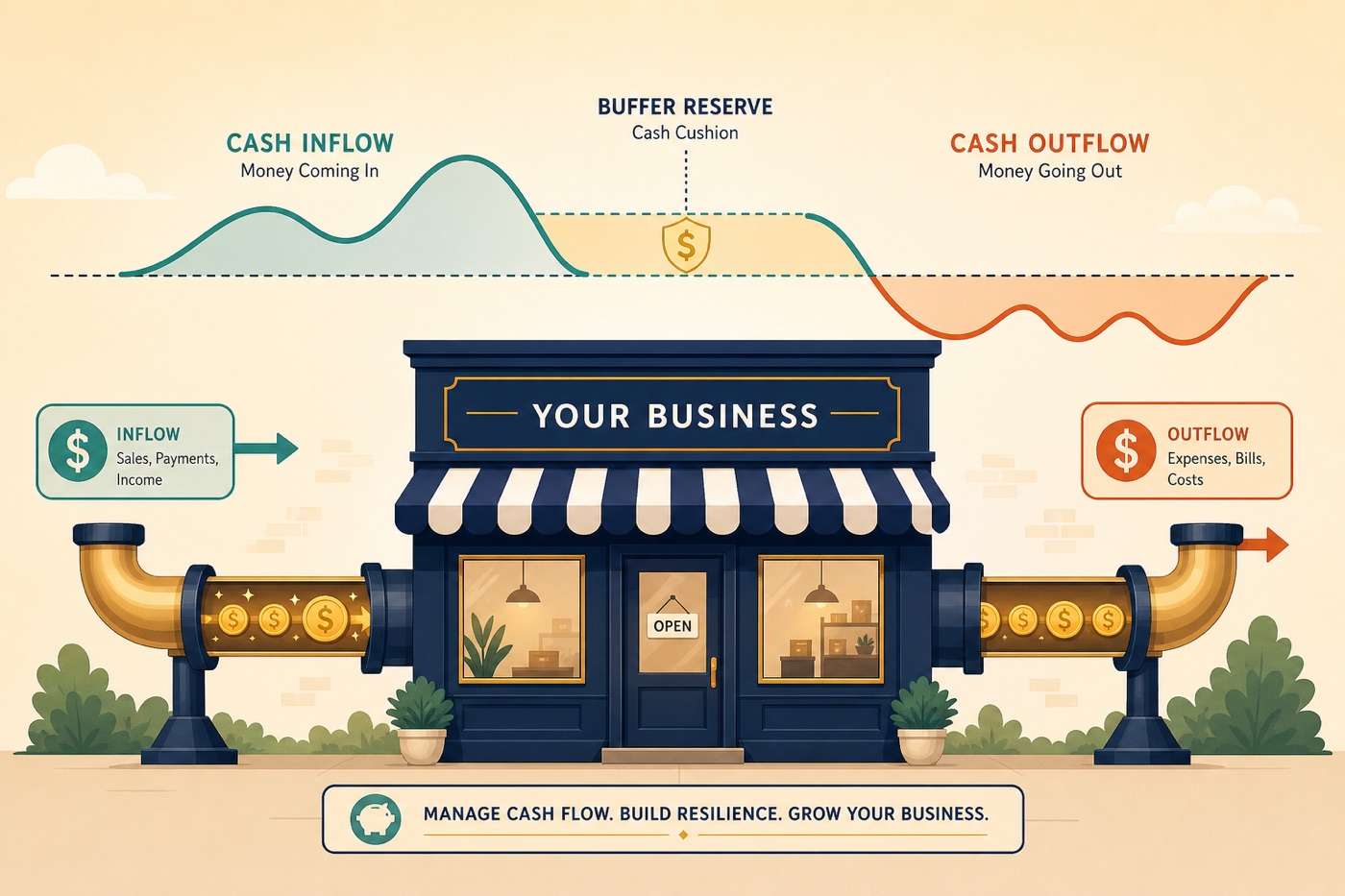
Every business has a cash conversion cycle – the time between when you spend money (inventory, materials, labor) and when you actually collect money for what that spending produced. A retailer who pays suppliers net-30 but sells for cash has a short, favorable cycle. A contractor who buys materials up front, does the work over six weeks, and then waits 45 days for the client to pay has a long, unfavorable one. The length of that gap is the single biggest predictor of whether you’ll need a cash cushion, and how big it needs to be.
The practical exercise is simple even if it’s tedious: for a typical job or sales cycle, write down the day you pay for inputs, the day you deliver, and the day you actually get paid. The number of days between the first and the last is your exposure. If that number is 45 days and your monthly fixed costs are $20,000, you need roughly $30,000 of buffer just to bridge one cycle without borrowing or delaying your own bills.
A cash flow forecast beats a bank balance
Looking at today’s bank balance and calling it “cash flow management” is like driving by looking only at where you are right now, never at the road ahead. A rolling 13-week cash flow forecast – a simple spreadsheet listing expected cash in and cash out week by week – is the standard tool for a reason. It’s short enough to be reasonably accurate and long enough to give you real warning.
The habit that actually makes this useful is updating it weekly with real numbers, not just projecting once and forgetting it. Every week, replace the forecast for that week with what actually happened, and roll the forecast forward another week. Within a month or two, you start to see your own patterns clearly – which customers reliably pay late, which months are seasonally tight, which expenses spike without warning – and the forecast gets more accurate because it’s built from your own history, not generic assumptions.
Levers you already have, before you reach for financing
The instinct when cash gets tight is to look for a loan or a line of credit. Those have their place, but they’re not the first lever to pull, because they add a fixed obligation on top of an already strained cash position. A few things to try first:
- Invoice faster and follow up sooner. Sending an invoice the day work is done instead of at month-end can pull payment forward by weeks. A polite reminder at the due date, not two weeks after, meaningfully improves collection speed for most small businesses.
- Negotiate payment terms on both sides. Asking a reliable supplier for net-30 instead of net-15 costs you nothing to ask and can materially shorten your cash gap. Likewise, offering a small discount for early payment from customers (2% for payment within 10 days is a common structure) can pull cash in faster than it costs you.
- Time discretionary spending to your cycle. Equipment purchases, non-urgent maintenance, and inventory restocking beyond immediate need can usually be shifted a few weeks to avoid colliding with a known tight period.
- Keep a genuine reserve, not just a buffer in checking. A separate account you don’t touch for day-to-day spending, sized to your mapped exposure from the exercise above, removes the temptation to treat it as available cash on an ordinary week.
When financing is the right tool, not a symptom
There’s a real difference between financing that bridges a known, temporary gap and financing that papers over a business that’s structurally losing money. A line of credit used to cover the 45 days between paying for materials and collecting from a client is a normal, healthy use of credit – it matches the tool to the timing problem. Using the same line of credit every single month just to make payroll, with the balance never actually going back to zero, is a different situation entirely and worth stepping back to address at the root, usually by revisiting pricing or the payment terms you’re extending to customers.
The U.S. Small Business Administration has solid, free guidance on cash flow management and the financing options available to small businesses, worth reading before you assume a loan is the answer: sba.gov. For a clear explainer of cash flow statements and how they differ from profit and loss, Investopedia’s breakdown is a good plain-English reference: investopedia.com. Neither replaces knowing your own numbers, but both are useful before you make a decision under pressure.