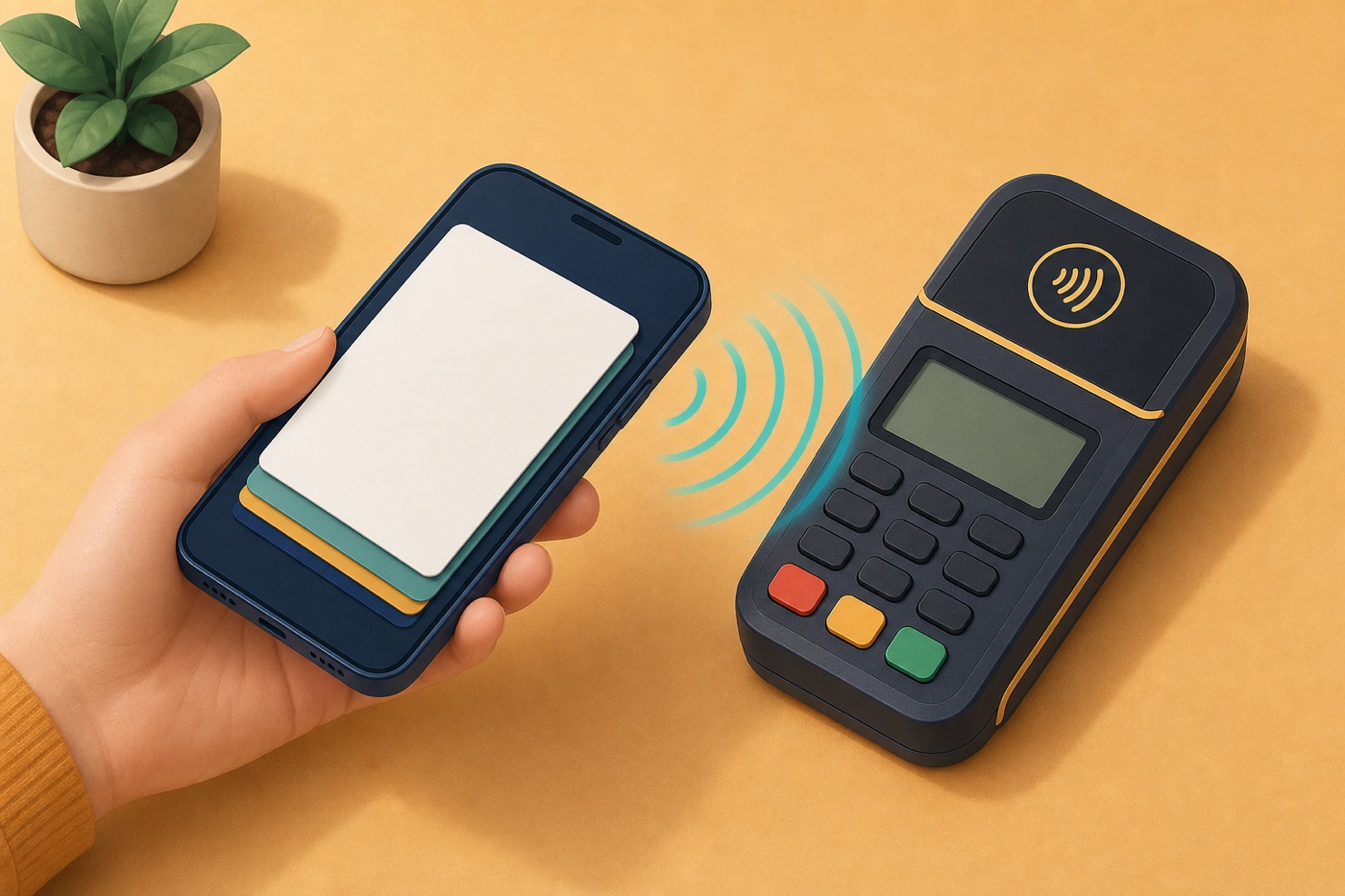
A few months ago I watched an older relative hesitate before tapping her phone at a checkout counter, convinced she was doing something faintly reckless. She’d swiped a physical card at that same register for twenty years without a second thought, but holding a phone over the reader felt, to her, like handing a stranger the keys to her account. I didn’t have a great answer for her on the spot, which annoyed me enough to actually go learn how the plumbing works. It turns out the tap is, if anything, the more cautious option of the two.
This is the primer I wish I’d had that day – what’s actually happening when you tap, how a phone-based wallet differs from a plain contactless card, and why the security story runs the opposite direction from what most people assume.
What’s actually happening when you tap
Contactless payment – whether from a card or a phone – relies on a short-range radio standard called Near Field Communication, or NFC. The reader and the chip exchange a tiny burst of data over a distance of a few centimeters, which is why you have to get close but don’t need to swipe or insert anything. That part is just a data channel; it doesn’t by itself explain why tapping is considered secure.
The part that matters is what gets sent over that channel. A contactless card transaction doesn’t transmit your plain card number the way an old-style swipe or a manually keyed-in online purchase might. Instead, the chip generates a cryptographic value unique to that specific transaction, so even if someone intercepted the exchange, replaying it wouldn’t produce a working charge. If you want the fuller technical picture, Investopedia has a solid plain-language rundown of how NFC actually functions under the hood.
A digital wallet is not just a photo of your card
People sometimes assume a phone wallet is basically a picture of their card that the phone shows to the reader. It isn’t. When you add a card to a wallet app, the card issuer typically doesn’t hand your real card number to the phone at all. It issues a substitute number – a token – that’s tied to that specific device and that specific wallet. If the token ever leaked, it wouldn’t work anywhere else and wouldn’t reveal your actual account number.
That’s the core difference between “digital wallet” and “contactless card”: a contactless card does its cryptographic dance using the chip embedded in the plastic itself, while a phone wallet does something similar using a tokenized credential stored in secure hardware on the device, gated behind whatever unlock method you’ve set up – a fingerprint, a face scan, a passcode. Both approaches converge on the same underlying idea: never send the real, reusable card number over the air.
Why this setup is generally safer, not riskier
The instinct that a screen and an antenna feel less trustworthy than a strip of plastic is understandable, but it gets the risk backwards in a few specific ways. First, tokenization means a compromised terminal or a skimmed transaction yields a token that’s useless for anyone trying to clone your card or shop elsewhere with your real number – which is precisely the failure mode that made magnetic-stripe fraud so persistent for decades. Second, a phone wallet generally requires biometric or passcode authentication before it will release payment credentials, so a lost or stolen phone doesn’t hand a thief a working payment method the way a lost wallet full of cards does.
There’s also a limit built into most contactless systems that people misread as an annoyance rather than a safeguard: after a run of small contactless taps, or above a certain cumulative amount, the terminal will suddenly ask for a PIN. That’s not the system malfunctioning – it’s a periodic check designed to catch a stolen card being used repeatedly for small amounts before anyone notices it’s missing.
A few practical habits worth adopting
None of this makes carelessness free, so a handful of habits are worth building in regardless of which method you use:
- Set your phone to lock automatically after a short timeout, and use biometric or passcode protection rather than none – the wallet’s security model assumes the device itself is locked down.
- Keep the number of cards loaded into any wallet to what you actually use; an old card sitting there is one more thing to remember to remove if your phone is ever lost.
- Know your issuer’s process for reporting a lost phone or a lost card before you need it – most let you freeze or remove a wallet credential remotely, and that’s much faster than canceling and reissuing a physical card.
- Check statements periodically rather than assuming tokenization makes review unnecessary; it prevents certain fraud patterns, not all of them.
- If a merchant’s contactless reader looks physically altered or has an odd attachment, that’s a card-skimming red flag worth trusting your instincts on – it’s a much older kind of fraud that predates any of this technology.
The short version is that tapping isn’t a shortcut around security, it’s a different and in most respects more defensive way of doing the same transaction. Once you understand that the phone or card is exchanging a disposable, transaction-specific credential rather than broadcasting your actual account number, the hesitation mostly evaporates – which is more or less what I told my relative the next time I saw her, and what finally got her tapping without the flinch.
