When a customer taps a card and the sale goes through, it feels free. It isn’t. Somewhere between the terminal and your bank account, a slice of that payment is skimmed off — and if you run a small business, those slices add up faster than most owners expect. I’ve watched founders obsess over a supplier quote while ignoring a card-processing rate that quietly costs them more every single month.
So let’s pull the fee apart and see where the money actually goes.
The three layers inside every card fee
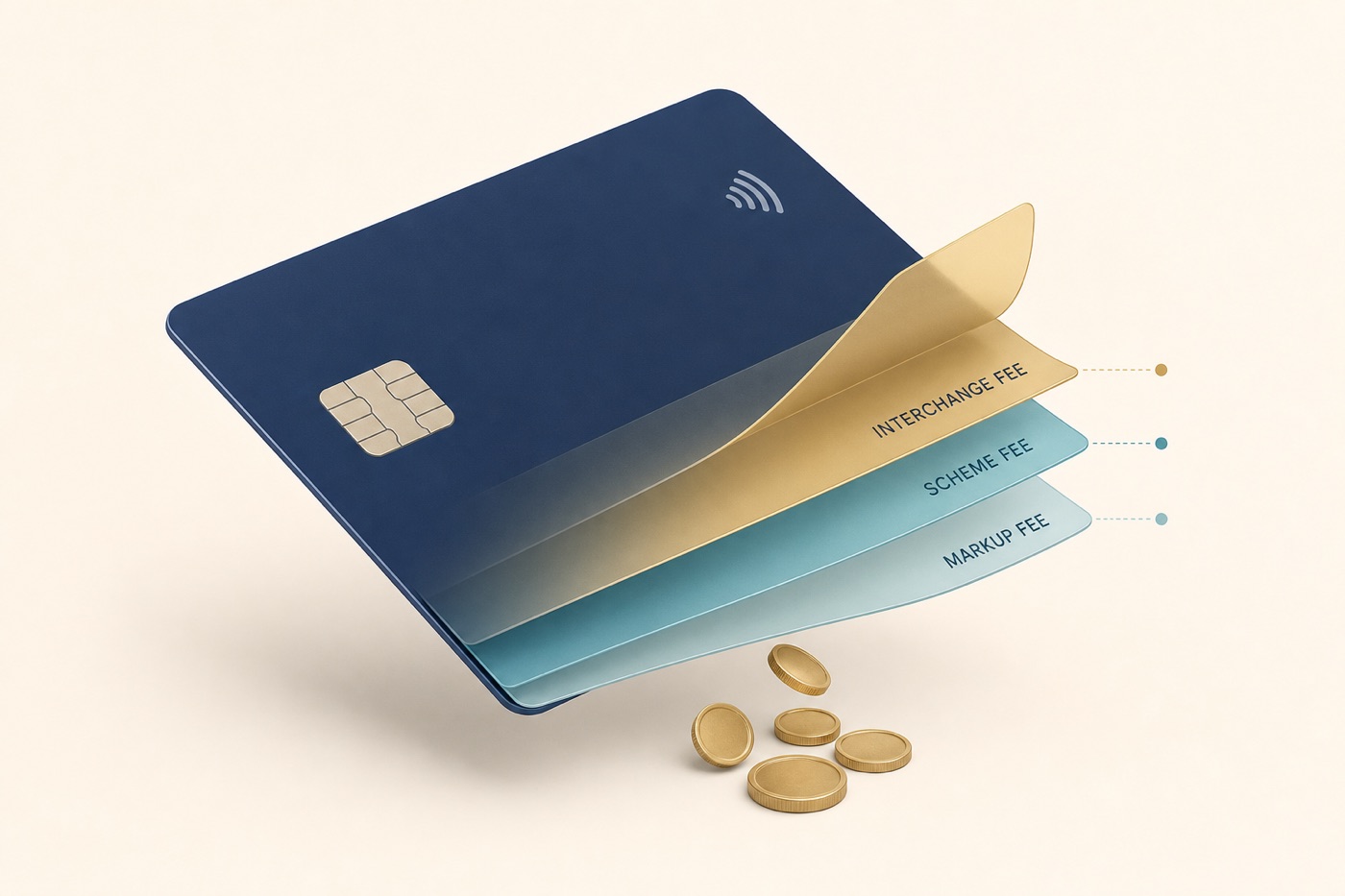
What you pay to accept a card is not one fee — it’s a stack of three:
- Interchange — paid to the bank that issued your customer’s card. This is usually the largest component, and it’s set by the card networks. It varies by card type: rewards and corporate cards cost more than a plain debit card.
- Scheme fees — charged by the card network itself (Visa, Mastercard and the rest) for routing the transaction.
- Processor markup — the margin your payment provider adds on top for the service, the technology and the support.
Interchange and scheme fees are effectively fixed — no provider can discount them, because they don’t keep them. The only part anyone competes on is the markup. That’s worth remembering the next time a sales rep waves a “low rate” at you: ask what sits inside it.
Flat rate vs interchange-plus
Most small businesses are offered a flat rate — a single blended percentage plus a small fixed amount per transaction, say something-percent plus a few cents. It’s easy to budget for and easy to understand, which is exactly why it’s popular. The trade-off is that it bundles all three layers into one number, so on cheaper card types you may be quietly overpaying.
The alternative is interchange-plus: the provider passes through the true interchange and scheme fees, then adds a transparent, fixed markup. It’s harder to read on a statement, but at higher volumes it’s usually cheaper and always more honest. As a rule of thumb, flat rate wins on simplicity for smaller merchants; interchange-plus wins on cost once your monthly volume climbs.
The fees that hide off the headline rate
The advertised percentage is rarely the whole story. Watch for the extras that don’t make the billboard:
- Cross-border and currency surcharges — accepting a foreign card, or settling in another currency, almost always carries an added percentage.
- Chargeback fees — a flat charge each time a customer disputes a payment, on top of the lost sale.
- Monthly, terminal, or minimum-volume fees — small line items that erode the “cheap” rate you signed up for.
Fee structures also differ sharply by market, because interchange itself is regulated differently around the world. If you operate in or sell into Asia, this breakdown of payment processing fees in the Singapore market is a clear, current example of how the components fit together and what a transparent provider actually charges — a useful reference point even if you trade elsewhere.
How to keep your effective rate honest
The number that matters is not the headline rate — it’s your effective rate: total fees divided by total card sales for the month. Calculate it from an actual statement, not a brochure. If it’s drifting above the quoted figure, something in the stack is working against you.
A few habits keep it in check. Read a full statement line by line at least once a quarter. Ask your provider to explain any charge you can’t identify. Consolidate fragmented tools — juggling a separate gateway, terminal provider and reconciliation service multiplies both fees and admin. And revisit your pricing model as you grow, because the flat rate that suited you at launch may be costing you real money once volume arrives.
None of this is complicated. It just requires treating card fees as a cost worth managing — because over a year, the difference between a lazy rate and a sharp one is often the price of a decent piece of equipment, or a month of someone’s salary.