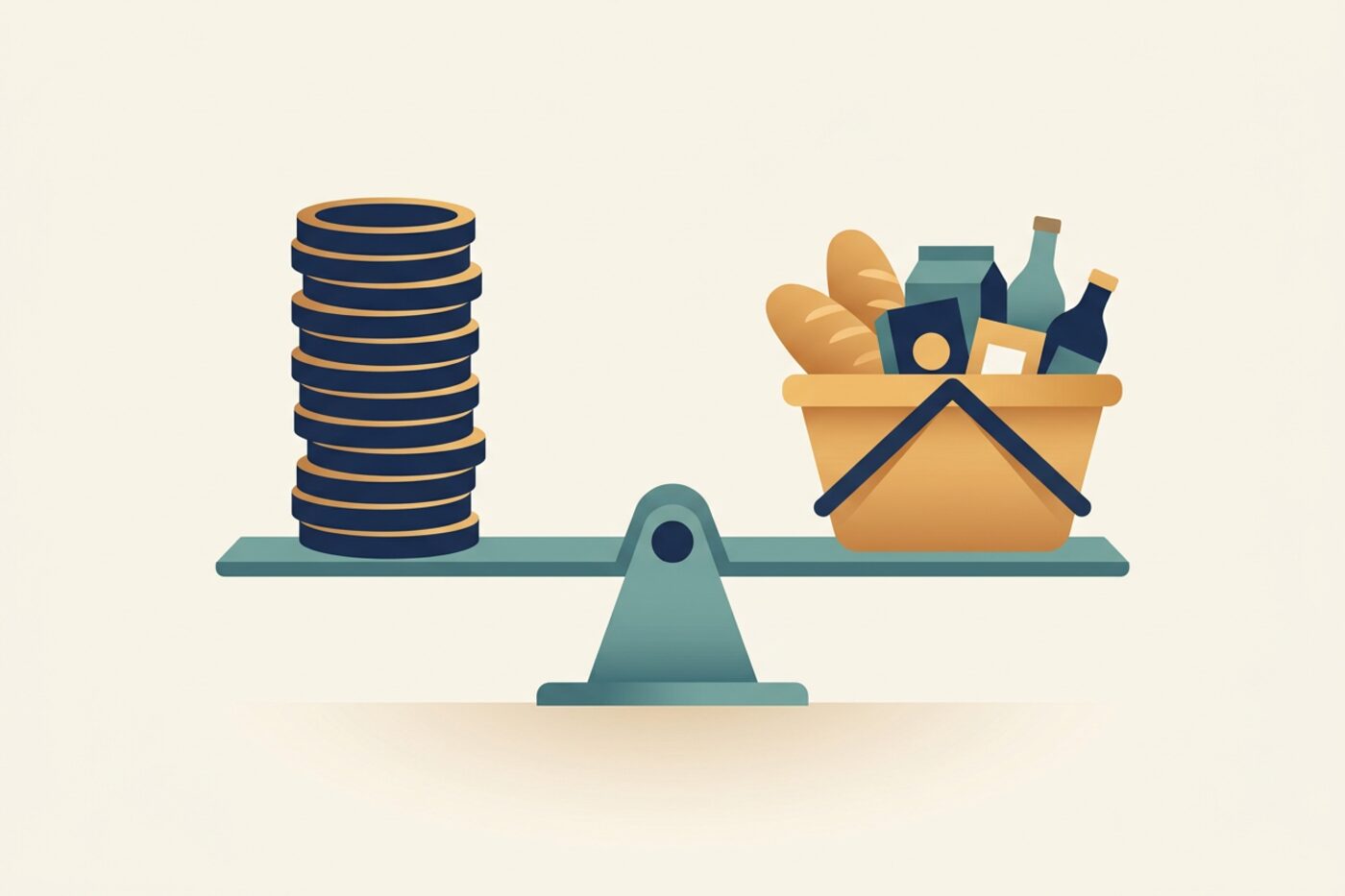
A few years ago I checked my savings account balance and it was exactly what I expected – the number had gone up, slowly, the way it’s supposed to. What I hadn’t checked was what that number could actually buy compared to a year earlier, and when I did the comparison, groceries, rent, and a handful of everyday purchases all cost noticeably more. The balance was fine. The purchasing power behind it wasn’t. That gap is what inflation actually does, and it’s easy to miss because your account statement never shows it directly.
This isn’t a doom-and-gloom piece about currency collapse or a pitch for any particular investment. It’s a plain look at what inflation is, why it quietly erodes cash sitting still, and what’s reasonable to think about in response – without pretending there’s a guaranteed way to beat it.
What inflation actually measures
Inflation is the rate at which prices for goods and services rise over time, which is the same thing as saying it’s the rate at which a fixed amount of money buys less over time. Most countries track this through a consumer price index that follows the cost of a representative basket of everyday goods – food, housing, transportation, utilities – and measures how that basket’s total cost changes month to month and year over year. In the US, this is published by the Bureau of Labor Statistics, and most other countries have an equivalent national statistics office publishing similar figures on a regular schedule.
The number that gets reported in the news is usually an average across a broad basket, which means your personal experience of inflation can differ meaningfully from the headline figure. If a larger share of your spending goes toward categories rising faster than average – housing in a tight rental market, say – your real-world cost of living can climb faster than the reported rate, and the reverse is also true.
Why cash sitting still is the most exposed
Money in a checking account, or under a mattress, or in a savings account earning little to no interest, has no defense against inflation at all. If prices rise three percent over a year and your cash earns nothing, you’ve lost purchasing power equal to that gap, in real terms, even though the number on your statement didn’t change. This is the least visible way to lose money, precisely because nothing dramatic happens – no crash, no bad headline, just a slow erosion that only shows up when you compare what the same amount buys across time.
This doesn’t mean cash is a mistake. Money you need in the next year or two – an emergency fund, a planned purchase, a tax reserve – genuinely needs the stability and immediate access that cash provides, and taking on price risk with money you can’t afford to see drop in value defeats the purpose of holding it in the first place. The tradeoff is specific to money you don’t need soon: for that portion, holding it entirely in low- or no-interest cash means accepting a slow, quiet loss in exchange for total stability.
What a reasonable response looks like
None of this is a case for chasing high returns to “beat” inflation, and be skeptical of anything that promises a specific way to guarantee it – inflation-beating returns are never certain, and higher expected returns generally come paired with higher risk of loss, not a free upgrade. A few things are worth understanding without crossing into specific advice:
- Interest-bearing accounts help, even if they don’t fully offset inflation. A savings account paying a meaningful rate loses purchasing power more slowly than one paying close to nothing – shopping around for a better rate on money you’re already holding as cash costs nothing and is rarely a bad idea.
- Time horizon changes what’s appropriate. Money needed soon has different priorities than money set aside for goals a decade or more away, and conflating the two is a common source of poor decisions in either direction.
- Diversification is a risk-management idea, not a returns guarantee. Spreading money across different types of assets is a way of not depending on any single outcome, not a method for ensuring a particular result.
For anything beyond these general observations – specific allocations, specific products, how much of your savings should sit where – a licensed financial adviser who knows your full situation is the right resource, not a blog post. What’s true broadly isn’t necessarily true for your particular timeline, risk tolerance, or country’s tax and account rules.
Keeping an eye on it without obsessing
You don’t need to track inflation figures monthly to make reasonable decisions. Checking in once or twice a year – alongside your regular budget review – on where your cash is earning interest, whether that rate is reasonably competitive, and whether your emergency fund and other near-term savings are sized appropriately given current prices, covers most of what matters for a household. The US Bureau of Labor Statistics publishes the Consumer Price Index data directly if you want to see the actual figures behind the headlines: bls.gov. If you’re outside the US, your central bank or national statistics office will publish an equivalent series, and it’s worth knowing where to find yours rather than relying on headline summaries alone.